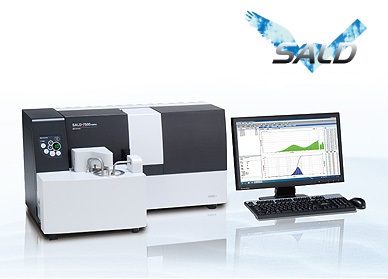
Nano Particle Size Analyzer - A powerful new tool for research and development in nanotechnology and life sciences, and for measuring fine bubbles.
High-sensitivity Measurement of Nano Particle Size Distribution.
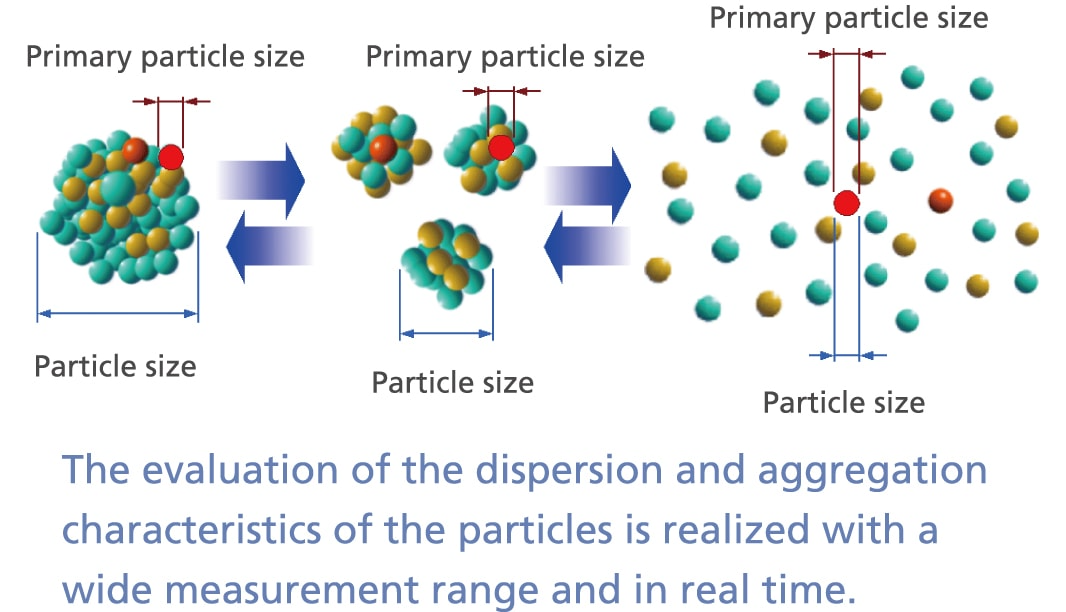
- Evaluation of the dispersion and aggregation characteristics of particles is realized with a wide measurement range and in real time.
- The SALD-7500nano was developed to provide accurate and high-sensitivity measurement of low concentration or high-light absorption nano particles. It achieves sensitivity in the nano area about ten times higher as compared to conventional instruments. In addition, low concentration samples of less than 1ppm can be measured.
- Enables measurement of fine bubbles(micro bubbles from 100 nm to 60 μm) ,and allows real-time tracing of the changes in the bubble diameter.
- This system enables the evaluation of sub-visible particles included in biopharmaceuticals. Special options can be added to create an aggregation property evaluation system for biopharmaceuticals.
QUICKLINKS TO FEATURES
Wide Measurement Range : 7 nm to 800 μm
From primary particles to sub-visible particles and contaminants
- Changes in particle size across the 7 nm to 800 μm measurement range can be continuously measured using a single light source, single optical system and single measurement principle.
- Since a primary particle and an aggregate and contaminant can be measured with one system, the aggregation properties by a dispersion condition can be checked.
The evaluation of the dispersion and aggregation characteristics of the particles is realized with a wide measurement range and in real time.
1-Second Minimum Serial Measurement Time. Real time monitoring
- By incorporating a single light source, which does not require switching, and the wide-angle detection method, the measurement time can be reduced to a minimum of 1 second. In addition, the particle size distribution can be displayed in real time at 1-second intervals.
- Serial observations of the dispersion, cohesion or dissolution reaction processes are possible at 1-secondintervals, and these results can be saved. Functions for statistical processing and 3D display of the particle reaction processes offer multifaceted analyses and evaluations.
- Connecting the flow cell directly to the fine bubble generator enables in-line real-time monitoring of the changes in fine bubbles.

Measure Concentrations from 0.001 ppm to 20%
- Compared to other instruments, the SALD-7500nano permits measurements across an extremely broad concentration range of 0.01 ppm to 20%.
- The particle size of fine particles, particularly nano particles, varies with the concentration.
The dispersion and coagulation of nano particles can be observed while altering the concentration.
- Accurate analysis of samples in which the particle size distribution changes with dilution is possible, as measurements can be conducted on the undiluted solution or after minimal dilution. For example, commercial hand creams, face creams, and rinses can be measured with hardly any pretreatment.
Measurement of Small Sample Amounts
- Drainage of a small quantity of a suspension liquid is adequate since the SALD-BC75 batch cell permits analysis of a volume of just 7 cm3. Most organic solvents can be used.
- A combination of the SALD-HC75 high-concentration sample measurement system with special glass slides featuring a shallow indentation permits measurement on just 15 micro liters.
Features of SALD-7500nano
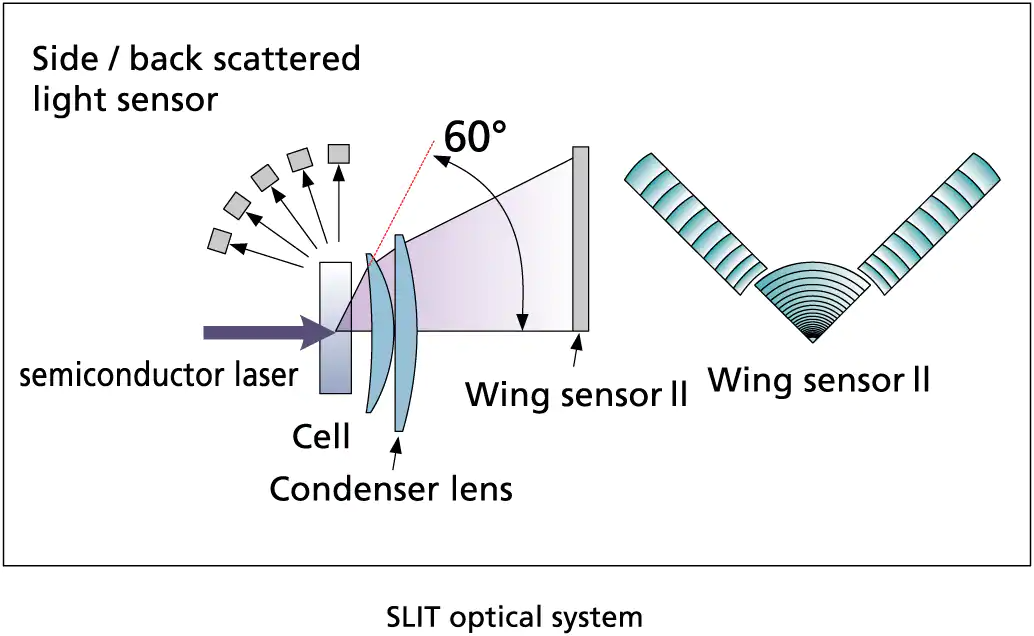
Single detection face continuously captures forward- scattered light up to a 60° angle

The target particle size range is seamlessly covered using a single measurement principle, single optical system, and single light source. Additionally, because the SALD-7500nano does not incorporate multiple optical systems that create discontinuities in the data, accurate particle size distribution measurements are possible across the entire measurement range using a single standard. The application of the SLIT* optical system, based on sophisticated scattered light intensity tracing technology, smashes conventional wisdom to continuously capture forward-scattered light at up to a wide 60° angle on a single detector face. This achieves high resolution in the fine particle region.
* SLIT (Scattered Light Intensity Trace)
High-Resolution / High-Sensitivity Wing Sensor ll

High-Resolution/High-Sensitivity Wing Sensor ll Forward diffracted/scattered light is detected by a “wing sensor ll”, a 76-element sensor developed using semiconductor manufacturing technology of the highest level. This sensor can detect greatly fluctuating small-angle forward scattering light with a high level of resolution and wide-angle scattering light of a low optical intensity with a high level of sensitivity. Also, side scattered light is detected by one sensor element and back scattered light is detected by four sensor elements. Accurately capturing light intensity distribution patterns with a total of 81 sensor elements enables the high-resolution, high-precision measurement of particle size distributions over a wide particle diameter range.
More Stable Optical System
The Omnidirectional Shock Absorption Frame (OSAF) fully isolates all elements of the optical system from shocks and vibrations. This eliminates concerns about adjusting the optical axis.
Built-in Self-Diagnostic Functions Ensure Easy Maintenance

These analyzers incorporate powerful self-diagnostic functions. The output signals sent by the sensors and detecting elements and the instrument operating status can be checked, facilitating easier maintenance. Using the Operation Log function, detailed information about, for example, the instrument usage status and contamination of the cells is included with all the measurement data, making it is possible to investigate the validity of measurement data obtained in the past.
Laser diffraction method ISO 13320 and JIS Z 8825-1 compliant
Tke SALD-7500nano complies with ISO 13320 and JIS Z 8825-1 laser diffraction and scattering standards.
Validation possible with JIS standard particles
System performances can be confirmed using a MBP1-10 standard particle specified in JIS Z8900-1. These samples have a broad particle size distribution, which is specified by the JIS standard. Using these samples allows verifying that the instrument is always accurate.
Allows verifying the validity of measurement results by referencing light intensity distribution data

Since light intensity distribution data (raw data) and measurement results (particle size distribution data) can be displayed on the same screen, measurement results can be verified while viewing both data sets. This allows users to verify whether the detection signal level (particle concentration) is appropriate, and to confirm the validity of measurement results from multiple aspects, such as in terms of the distribution width and the presence of aggregates and contaminants.
Wide application applicability
The system configuration can be optimized to address various uses, purposes, measurement objects, environments and conditions.

Software Features
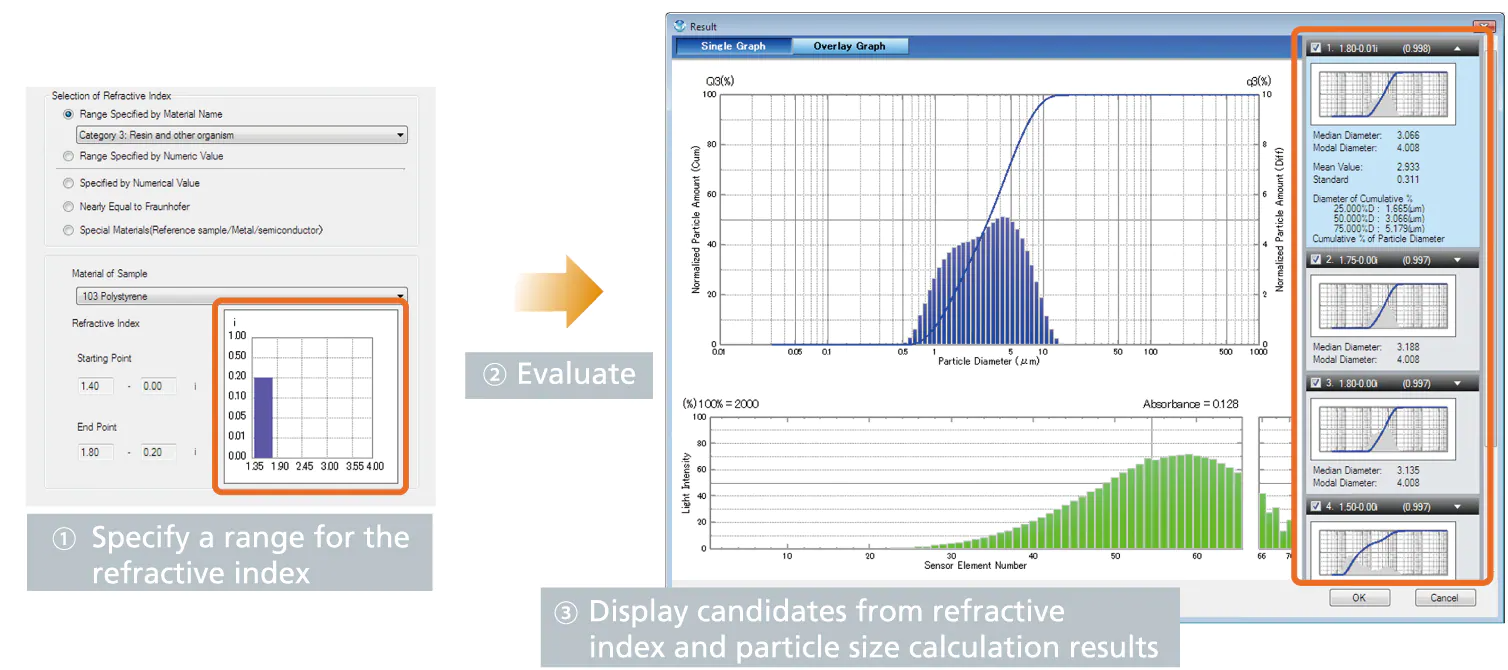
Eliminates the mistake or trouble of selecting refractive indices
Automatic Refractive Index Calculation Function
Selecting a refractive index was an unavoidable part of using the laser diffraction method, where generally a published value was entered, but such values were not necessarily appropriate, considering the effects of particle composition and shape. Therefore, tedious trial and error processes were used to select refractive indices.
WingSALD II solves such problems by being the world's first software to include a function that automatically calculates an appropriate refractive index based on the LDR (light intensity distribution reproduction) method.

Assist function decreases operational error to ensure more accurate measurement
Measurement Assistant Functions: allow preparing SOPs to ensure measurements are always performed using the same conditions and procedures.
Creating, saving, and sharing measurement conditions and procedures, including pretreatment methods and conditions, ensures measurements are performed using the same conditions and procedures, even if performed by a different operator or at a different location or plant, and allows safely comparing data.
Furthermore, when the measurement assistant function is used, measurement instructions for the operator are displayed on the screen. This enables even inexperienced operators to perform measurements correctly. In addition, administrators and operators can be assigned different operating privileges to ensure security.
Note: SOP is an acronym for Standard Operating Procedure.

Particle size distribution data and light intensity distribution data can be displayed in real-time
This means that changes in the sample over time or shifts in the dispersion status can be monitored in real time. Since both the light intensity distribution data, which is the raw data, and particle size data can be monitored simultaneously, both data sets can be compared to monitor any changes in the status of samples.

Continuous measurement of 1-second interval particle size changes
Changes in particle size distributions and particle diameters are measured continuously, at intervals as short as one second, and the results are saved. Furthermore, the results can be subjected to multifaceted analysis and evaluation using functions such as 3D graphing. For example, the reaction processes that occur when particle groups disperse, aggregate, or dissolve can be monitored

This is an example of light intensity distribution data and particle size distribution data for the dissolution process of calcium carbonate. It shows how dissolution progresses from smaller diameter particles and how the normalized amount of large particles increases.
Measurement data from multiple facets – Extensive assortment of data analysis applications included standard –
The following data analysis applications are included standard.
Evaluation of Scattering Angle
Graphs the components of scattered light intensity at each angle. Taking advantage of the features of the highly integrated photodiode array, it allows evaluating low-angle scattered light with high resolution.
Application Fields : Evaluating the scattering characteristics of films and sheets
Data Emulation Function
Based on SALD series measurement results, this function allows emulating measurement results obtained using other models and measurement principles. This ensures data compatibility with previous measurement methods.

51 conversion expressions can be obtained at the cumulative % points (0.01%, 2%, 4% …… 96%, 98%, 99.98% on vertical axis) to express the relationship between the particle size distribution data measured by SALD-7500nano and that measured by another instrument or technology.
102 parameters ai (i = 1,2,..…, 51) and bi(i = 1,2,..…, 51) used in 51 conversion expressions can be stored as a parameter table, which can be used for emulations.
This emulation function may be able to reduce some problems when an old particle size analyzer is upgraded to a new instrument.
The same samples must be measured by two instruments in order to develop the parameter table for emulations.
Mixture Data Simulation Function
Allows simulating particle size distributions using any mixture ratio of multiple particle size distributions. This makes it possible to determine the optimal mixture ratio for obtaining the desired particle size distribution, without the trouble of repeatedly measuring the particle size distribution of sample mixtures.
Data Connecting Function
Allows combining the measurement results for two different measurement ranges at any particle size point to create a single particle size distribution. For example, sieve data for particles above 2000 μm can be combined with SALD series data for particles below 2000 μm to create a wide-ranging particle size distribution, which is required for civil engineering, disaster prevention, and environmental fields.
More efficient processing of multiple sets of data
Multiple sets of data can be stored as a group. In addition to organizing the data, it makes redisplaying and reanalyzing it easier. Data can be loaded as a group and displayed or analyzed at the same time, rather than having to load each set of data separately.
Note: The LDR method automatically calculates an appropriate refractive index based on consistency between the actual measured light intensity distribution and one reproduced (recalculated) from particle size distribution data. This method was developed by Shimadzu and published in two technical papers. It is sometimes called the "Kinoshita Method", in academic communities, after the name of Shimadzu’s engineer.
System Structure
An evolved nano particle size analyzer for accurate evaluation of nano particles
Main unit (Measurement unit): SALD-7500nano
- Violet semiconductor laser (wavelength: 405 nm) is used for the light source. Maintenance, such as gas replacement, is unnecessary.
- The detector incorporates 78 elements at the front, one element at the side, and 5 elements at the back for a total of 84 elements. Additionally, high-sensitivity light receptors that support violet semiconductor laser wavelengths are adopted with all detectors.
- The fixed parts of the cell and cell holder can be pulled out at the front of the unit using a slide mechanism. This makes it easy to mount and replace cells, and to perform maintenance.
- WingSALD ll software is supplied as standard. It offers versatile data processing and simple, high-speed operation to suit every purpose and processing requirement.
Add optional units to the SALD-7500nano to design a wide range of systems.

The batch cell and the high-concentration sample measurement system can be set in the measurement unit.
Small-volume Measurement System (SALD-7500nano and SALD-BC75)
High-Concentration Sample Measurement System (SALD-7500nano and SALD-HC75)
Ultra Small-Volume Measurement System (SALD-7500nano and SALD-HC75 and “Glass Slides with Indentation”)

Easy Measurement under PC Control Sampler SALD-MS75

- Groups of particles are dispersed in a liquid medium and measured as they are circulated between the flow cell, which is placed in the measurement unit, and a dispersion bath in the sampler.
- The dispersion bath incorporates a stirrer and an ultrasonic sonicator. A pump delivers the dispersed suspension to the flow cell.
- The pump is specially designed to ensure both liquid medium and the particles are circulated. A stainless ball of 2 mm circulates and it is possible to measure it.
- It can be controlled from a PC.
- Most organic solvents can be used as dispersion media.
Sample Unit SALD-MS75 Solvent Resistance

Measurement data
Note 1: Solvent resistance toward materials used in the passageways of SALD-MS75. Solvent resistance values are representative, and are not certified.
Note 2: Only applicable for liquid pump. Not applicable for liquid supply pump.
Note 3: Ultrasonic cleaning instruments are needed for the measurement of reference sample.

Ideal for Measurement with Small Amounts of Organic Solvent
Batch Cell SALD-BC75

- Measurement is possible with a small amount of sample (i.e., measured particles) and liquid medium (i.e., dispersion medium).
- The capacity of the batch cell is only 7cm3 an so waste treatment for the suspension canbe performed with relatively small amounts.
- The vertical motions of the stirring plate prevent sedimentation of the particles.
- The funnel reduces the possibility of sample spillage.
- A tetrafluoroethylene resin funnel is provided to reduce the possibility of suspension getting on the hands of the user. It also prevents the cell surface from becoming dirty.
Measurement data
<
Measurement Samples without Dilution
High-Concentration Sample Measurement System: SALD-HC75
- High-concentration samples can be measured using the laser diffraction method.
- Measurement is possible by simply holding the high-concentration sample particles to be measured between two glass slides.
- Samples for which the particle size distribution would be changed by dilution can be measured in their original state, or with the minimum required level of dilution, and a true image of the measurement object can be obtained.
- Commercial hand creams, face creams, and rinses can be measured with hardly any pretreatment.

If a standard flow cell or batch cell is used to measure a sample at a high concentration, the long light pathlength results in multiple scattering, making it difficult to obtain accurate measurements.
With this system, however, it is possible to hold the high-concentration sample particles between two glass slides, which shortens the length of the light paths, avoids the negative effects of multiple scattering and makes accurate measurement possible.
Glass sample plates (glass with indentation) (Option)

Effective for measuring samples with relatively low concentrations, or expensive samples that can only be used in small amounts.
Measurement Data

General Specifications
| Measurement principle |
Laser Diffraction Method |
| Measurement range |
7 nm (0.007 μm) to 800 μm (when using sampler)
7 nm (0.007 μm) to 400 μm (when using batch cell)
30 nm (0.03 μm) to 280 μm (when using high-concentration sample unit) |
Note 1: The measurement range varies according to the shape etc. of the particle.
Measurement unit : SALD-7500nano
| Light source |
Semiconductor laser (Wavelength 405 nm) |
| Light detector |
Detector elements for violet semiconductor laser Total 84 elements
(78 forward, 1 side, 5 back) |
| System compliance |
Class 1 Laser Product, CE |
| Required power supply |
AC 100 V±10%, 1 A, 50/60 Hz |
| Dimensions & weight |
Approx. 680 × D280 × H430 mm, Approx.32 kg |
| Operation environment |
Temperature : 10 to 30°C , Humidity : 20 to 80% (no condensation) |
Note 2: Reference sample and USB cable (2 m) supplied as standard
Note 3: Ultrasonic cleaning instruments are needed for the measurement of reference sample.
Sampler : SALD-MS75
| Dispersing bath |
Capacity : 100 / 200 / 300 mL |
| Sonicator |
Frequency : about32 kHz, output : about 40 W |
| Liquid pump |
Radial pump, maximum flow rate 2000 cm3/min |
| Liquid pump material |
Stainless (SUS 304, SUS 316), Tetrafluoroethylene (PTFE),
Perfluoroelastmor (FEP) |
| Liquid supply pump |
Diaphragm pump, maximum flow rate : 750cm3/min |
| Liquid supply pump material |
Polypropylene |
| Flow cell |
Quartz glass |
| Required power supply |
AC 100 V±10%, 2 A, 50/60 Hz |
| Dimensions & weight |
Approx. W390 × D520 × H430 mm, Approx.18 kg |
| Operating environment |
Temperature: 10 to 30°C, Humidity: 20 to 80% (no condensation) |
Note 4: USB cable (2 m) supplied as standard
Batch Cell : SALD-BC75
| Cell material |
Quartz glass |
| Required liquid volume |
Approx. 5 cm3 |
| Stirrer mechanism |
Up-and-down movement of blade |
| Dimensions & weight |
Approx. W100 × D120 × H140 mm, Approx. 0.8 kg |
| Operating environment |
Temperature: 10 to 30°C, Humidity: 20 to 80% (no condensation) |
High-concentration Sample Measurement System : SALD-HC75
| Cell material |
Borosilicate glass |
| Required liquid volume |
Approx. 0.15 cm3 |
| Dimensions & weight |
Approx. W20 × D100 × H9 mm, Approx. 0.2 kg |
| Operating environment |
Temperature: 10 to 30°C, Humidity: 20 to 80% (no condensation) |
Software
WingSALD II
| Measurement and Data Display Functions |
| Measurement of Particle Size Distribution |
Allows measurements using measurement assistant unction (interactive process based on SOP) and manual mode |
| Automatic Calculation of Refractive Index |
Automatic calculation by Light Intensity Distribution Reproduction (LDR) method based on specified substance name or range |
| Real-time Display |
Particle size distribution / Light intensity distribution simultaneous display |
| Recalculation of Particle Size Distribution |
Max. 200 data batch calculation or individual data calculation |
| Display of Particle Size distribution Data |
Max. 200 data overlay graph or individual data graph |
| Display of Light Intensity Distribution |
Max. 200 data overlay graph or individual data graph |
| Diagnostics/Adjustments |
Self-diagnostic functions |
| Statistical Data Processing |
Max. 200 data (Max. 200 data overlay graph) |
| Time Series Analysis |
Max. 200 data |
| 3-Dimensional Graph |
Max. 200 data |
| Data Transfer via Clipboard |
Image Output, Image Output |
| Data Sorting |
Sort by file name, sample ID, sample number, or refractive index. |
| Output Conditions |
| Particle Size Distribution (μm) Number of Divisions |
Fixed 51 / 101 divisions / Optional (can be set by user) 51 divisions * 10 tables |
| Particle Mass Distribution (%) Number of Divisions |
Fixed 51 divisions, Optical (can be set by user) 51 divisions * 10 tables |
| Dimension of Particle Amount |
Count, length, area or volume |
| Expression of Cumulative Distribution |
Undersize, oversize |
| Expression of Data Frequency |
q, q / Δ×, q / Δlog× |
| Smoothing Level |
10 Level |
| Distribution Function Fitting |
Rosin-Rammler distribution, logarithmic Gaussian distribution |
| Data Shifting |
±10 levels |
| Report Functions |
Batch output possible by selecting single data (template 6), overlay data ( template 5), statistical data, time-series data, or 3D data |
| Data Analysis |
| Scattering Angle Evaluation |
Max. 200 data overlay graph or individual data graph |
| Data Conversion Function |
Emulation of particle distribution data by other instruments or measuring principles |
| Mixing Simulation Function |
Max. 6 points |
| Data Connection Function |
2 data connections |
| Continuous Measurements Function |
Measurement interval: 1 s min., Save up to 200 data points |
| Note 5: |
The Light Intensity Distribution Reproduction (LDR) method calculates the refractive index from the conformity between the measured light intensity distribution pattern and the light intensity distribution data reproduced (calculated) from the particle size distribution data. LDR is a proprietary method developed by Shimadzu. Two papers have been published on this method. It is sometimes called the "Kinoshita Method" at academic conferences. |